Mandalas & Self-Care: How the Simple Circle Can Calm Your Mind and Recenter Your Heart
Discover how mandalas can support your self-care routine. Learn the science behind mandala art, how coloring reduces stress and anxiety, and simple ways to use mandalas for mindfulness and emotional healing.
SELF CARE BLOG
10/21/20253 min read
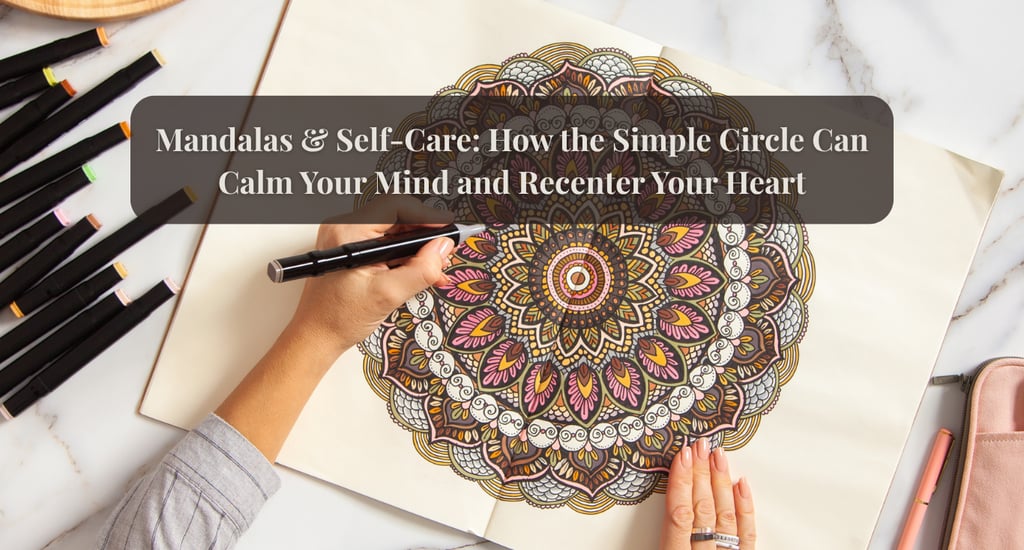
There’s something quietly magnetic about a circle filled with patterns. Maybe it’s the symmetry. Maybe it’s the way your hand moves inside the boundary, either way mandala’s truly have a relaxing effect. And when coloring one, the outside world can just fade away for a little while.
Mandalas - literally meaning “circle” in Sanskrit - have been used across cultures for centuries. Once found in temples and sacred art, they’re now part of modern wellness and self-care routines. And it’s no surprise why. The act of coloring or creating a mandala can help calm your mind, reduce stress, and bring a sense of peace back to your day.
What Exactly Is a Mandala?
A mandala is a circular design filled with repeating shapes, colors, or patterns that radiate from the center outward. You’ll find versions in Tibetan sand mandalas, Hindu yantras, Native American medicine wheels, and stained-glass rose windows.
Across traditions, mandalas symbolize balance, harmony, and wholeness - the way life circles inward and outward, much like our breath or emotional rhythm.
The Psychology Behind Mandalas
Swiss psychiatrist Carl Jung was one of the first to explore mandalas in modern psychology. He noticed that people naturally drew circular images during times of emotional stress or transformation. Jung believed mandalas represented the Self - a visual expression of our mind seeking balance and unity.
Today, therapists use mandalas as tools for mindfulness and emotional healing. The structure of the circle creates a safe space for self-expression, especially when words are hard to find.
The Science: How Mandalas Support Mental Wellness
Modern research continues to confirm what ancient traditions already knew: mandalas are deeply soothing.
Reduced Anxiety: A 2005 study by Nancy Curry found that coloring pre-drawn mandalas significantly reduced anxiety levels compared to free-form drawing.
Stress Relief & Focus: More recent research (Nasiri et al., 2024) showed that short mandala-coloring sessions lowered stress in college students and helped with emotional regulation.
Emotional Healing: Systematic reviews (Zhang et al., 2024) suggest mandala art therapy can improve mood, promote calmness, and even help regulate physiological stress markers.
The beauty lies in their accessibility - you don’t need to be an artist to benefit. Just color, breathe, and be present.
Why Mandalas Work
Here are some reasons why this simple circular art can have such a powerful effect on the mind:
🌀 Mindfulness in Motion: The repetitive action of coloring or drawing pulls you into the present moment.
🌀 Flow State: Focusing inside the circle can help your mind “flow” — a peaceful, immersive state that quiets mental chatter.
🌀 Containment: The boundary of the circle creates emotional safety. You can release feelings and thoughts into the design without judgment.
🌀 Creative Calm: Mandala-making gives you freedom to express yourself in a structured, soothing way — no rules, no perfection required.
Simple Mandala Self-Care Practices
1. 10-Minute Mandala Calm
Grab a printable mandala or a coloring book.
Choose a few calming colors.
Set a timer for 10 minutes and let yourself color in silence or with soft music.
Notice your breathing as you fill in each space.
2. Emotion Mandala
Draw a circle. In the center, use colors or symbols to represent how you feel.
Build outward, adding layers for what soothes or intensifies that emotion.
Reflect on your finished piece — it’s your emotions, visualized and safely held.
3. Mandala Meditation
Gaze softly at a mandala.
Inhale deeply as your eyes move toward the center, exhale as they move outward.
Repeat for a few minutes, using the rhythm to relax your mind and body.
4. Create Your Own Mandala
Draw a simple circle.
Place a symbol or word in the middle (like “peace,” “love,” or “strength”).
Let your pen or pencil radiate shapes outward - imperfectly, beautifully, freely.
How to Add Mandalas to Your Self-Care Routine
✨ Add a short mandala coloring break to your week - just 10 minutes can help reset your mood.
✨ Pair mandala time with your favorite tea or playlist.
✨ Keep a mandala journal to track your emotions and growth over time.
✨ Try a group mandala activity with friends or family - shared creativity builds connection.
Cultural Awareness
Mandalas come from rich spiritual and cultural traditions. When using or sharing them, do so with respect. Acknowledge their origins in Hinduism, Buddhism, and Indigenous symbolism, and avoid trivializing sacred imagery.
Final Thought
Mandalas remind us that healing and harmony often begin at the center…one quiet moment, one circle at a time.
Whether you color one to unwind at the end of a stressful day or create your own to express emotion, the practice offers a simple yet powerful path back to balance, calm, and self-connection.
Downloadable 4 Week Mandala Self-Care Challenge
“Each person's life is like a mandala – a vast, limitless circle.”
With Love,
Radiance Retreat